• Home >
  • Back Issues >
  • Laser Focus World >
  • Volume 57, Issue 03
  • Volume 57, Issue 03

    More content from Volume 57, Issue 03

    A band-structure-engineered longwave-infrared (LWIR) heterojunction phototransistor based on a type-II superlattice has potential for astronomy, remote sensing, and other uses...
    March 24, 2021
    (Image credit: SIOM)
    Field testing of a het Φ-OTDR fiber-optics hydrophone attempting to locate a sound source shows good angular-sensing agreement between actual and measured angles for signals at 375 and 625 Hz (a). When the sound source is moved over time the cable accurately tracks it (b).
    A mandrel spirally wound with sensitized optical fiber, all sheathed for underwater use, is the sensor for a heterodyne coherent detection (het Φ-OTDR)-based hydrophone.
    March 24, 2021
    (Image credit: Andrew Traverso, Duke University)
    A plasmonic metasurface plus fluorescent layer takes widely angularly dispersed input light and emits light in a much-narrower cone. In the device, four layers of fluorescent-dye-packed polymer separate a layer of 60 nm nanocubes from a thin silver layer; interaction between the nanocubes and the silver layer enhance emission from the dye.
    Silver nanocubes combined with fluorescent dye form an efficient converter of diffuse input light to concentrated output light.
    March 24, 2021
    FIGURE 1. Schematic diagram of a conventional spatially heterodyned spectrometer (SHS). L1 and L2 indicate the two collection and imaging lenses, respectively, and BS indicates a 50/50 beamsplitter. G1 and G2 indicate blazed gratings, aligned at the Littrow angle (ΘL).
    Recent advances in spatially heterodyne spectrometer (SHS) design expand their usage in new applications.
    March 24, 2021
    (Image credit: University of Cantabria)
    Spectral reflectance properties of the bubble-shaped Fabry-Perot cavity and an independent in-fiber grating allow this sensor to simultaneously detect tissue contact and measure the refractive index of the local environment.
    A needle-encased “lab-in-fiber” simultaneously measures both compressive stress and refractive index for medical sensing.
    March 24, 2021
    FIGURE 1. Original point cloud from 32-channel lidar (left) and noise reduction after further refining the calibration of individual channels using Optech LMS software (right).
    A terrain-mapping lidar system benefits from robust self-calibration and post-processing capabilities.
    March 24, 2021
    (Courtesy of TuSimple)
    FIGURE 1. Lidar with a 200 m range used on the TuSimple autonomous truck is shown; this is mounted on one side of the hood of the tractor unit, above and slightly behind the headlight. A second lidar is above the other.
    Photonic integration has become a key technology for bringing costs down and achieving the performance needed for autonomous vehicles.
    March 24, 2021
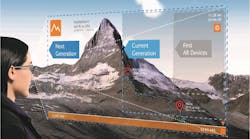
    FIGURE 1. The next generation of AR devices will display a FOV large enough to layer useful information over a significant expanse of natural human vision, while remaining lightweight and allowing the user to focus comfortably on both the information and the view.
    High-index glass wafers are the basis of flexible waveguide designs that bring a new generation of full-immersion augmented reality eyewear closer to fruition.
    March 24, 2021
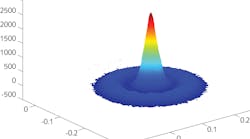
    FIGURE 1. Experimental irradiance profiles of a laser beam with a Gaussian beam profile (left) and another beam featuring a flat-top beam profile (right) [1].
    Flat-top beams have many application-dependent advantages over Gaussian beams; learn how best to generate a flat-top beam for your needs.
    March 24, 2021
    (Image credit: SIOM)
    An experimental setup (top) for measuring the linear EO coefficient of K(H1-xDx)2PO4 crystals (note the voltage V being applied across the DKDP crystal; this widens the crystal’s acceptance angle); FHG characteristics of DKDP crystals with differing deuterium contents based on voltage-tuned phase matching (VTPM) measurements (bottom left); and measured linear EO coefficients of K(H1-xDx)2PO4 crystals.
    To measure the linear electro-optic coefficient of KDP and DKDP crystals, a voltage is applied to widen the crystal’s acceptance angle, making measurement easier.
    March 24, 2021
    FIGURE 1. An MR-15-30 dual-axis voice-coil mirror (VCM) is shown with protected gold coating.
    A 2D voice-coil mirror unit is compact, shock-resistant, and widely scannable.
    March 24, 2021
    2105 Lfw Lpms Supp 9a
    The world is changing and so are the global laser markets. Find out how by viewing Laser Focus World’s on-demand Lasers & Photonics Marketplace Seminar.
    March 11, 2021
    (Credit: wei zhu/Pixabay)
    City 5000648 1920
    China’s economic growth has transformed it from a low-end supplier of optical components into an enormous market for lasers and a critical part of the international photonics ...
    March 10, 2021
    (Image credit: U.S. Army)
    A Rydberg receiver and spectrum analyzer above a microwave circuit can detect a wide range of real-world radio frequency signals, including AM radio, FM radio, Wi-Fi, and Bluetooth.
    A Rydberg receiver and spectrum analyzer detects a wide range of real-world radio frequency signals above a microwave circuit, including AM radio, FM radio, Wi-Fi, and Bluetooth...
    Feb. 4, 2021
    Jonghyun Kim, Nvidia, Stanford University
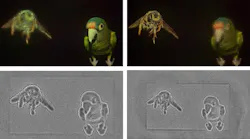
    A camera-in-the-loop (CITL) optimization process improves holographic images. Top images show captured near- and far-plane focal images acquired with the optimization process while the bottom images show the two phase images used to create the hologram.
    Michelson holography plus better optimization software could make holography more viable for AR/VR and other applications.
    Feb. 2, 2021